

“A sibling may be the keeper of one’s identity, the only person with the keys to one’s unfettered, more fundamental self.”
– Marian Sandmaier
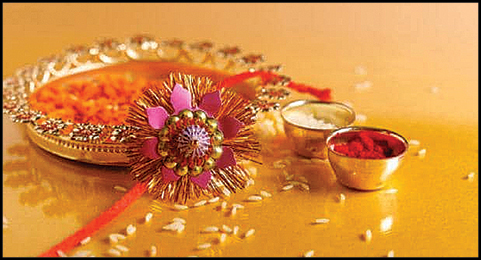
Relationships are the essence of any festivity and it holds true for any Indian festival. Each occasion brings the family together which calls for a celebration. Raksha Bandhan is a celebration of one such relation – that of a brother and a sister. It is called the the bond of protection by some. It is also popularly known as Rakhi. The festival primarily celebrates the relationship between a brother and a sister. However, a protection bond can be between any two individuals. It is also called Rakhi Pu
ima in the South. The ceremony involves the tying of a rakhi (sacred thread) by a sister on her brother’s wrist. This symbolizes the sister’s love and prayers for her brother’s well-being, and the brother’s lifelong vow to protect her. The festival falls on the full moon day (Shravan Poo
ima) of the Shravan month of the Hindu lunisolar calendar. It grew in popularity after Rani Ka
avati, the widowed queen of Chittor, sent a rakhi to the Mughal emperor Humayun when she required his help. Rakshabandhan has a great historical context. Below are the few stories associated with the festival:
*Story of Lord Krishna and Draupadi: Another incident from the epic Mahabharat conce
s Krishna and Draupadi, the wife of the Pandavas. She had once to
a strip of silk off her sari and tied it around Krishna’s wrist to staunch the bleeding from a battlefield wound. Krishna was touched by her action and declared her to be his sister, even though they were unrelated. He promised to repay the debt and then spent the next 25 years doing just that. Draupadi, in spite of being married to five great warriors and being a daughter of a powerful monarch, trusted and depended wholly on Krishna. Krishna repaid the debt of love during the “Cheer-Haran” (literally “clothing-removing”) of Draupadi, which occurred in the assembly of King Dhritarashtra when Yudhisthira lost her to the Kauravas in gambling. At that time, Krishna indefinitely extended her saree through divine intervention, so it could not be removed, to save her honor. This is how he honored his rakhi vow towards Draupadi.
* Story of King Bali and Goddess Laxmi: According to a legend the Demon King Bali was a great devotee of Lord Vishnu. Lord Vishnu had taken up the task to guard his kingdom leaving his own abode in Vaikunth. Goddess Lakshmi wished to be with her lord back in her abode. She went to Bali disguised as a woman to seek refuge till her husband came back.
During the Shravan Pu
ima celebrations, Lakshmi tied the sacred thread to the King. Upon being asked, she revealed who she was and why she was there. The king was touched by her goodwill for his family and her purpose and requested the Lord to accompany her. He sacrificed all he had for the Lord and his devoted wife.
Thus devotion to the Lord. It is said that since then it has been a tradition to invite sisters in Shravan Pu
ima for the thread tying ceremony or the Raksha Bandhan.
*Story of Alexander the Great and King Puru: According to one legendary narrative, when Alexander the Great invaded India in 326 BC, Roxana (or Roshanak, his wife) sent a sacred thread to Porus, asking him not to harm her husband in battle. In accordance with tradition, Porus, a Katoch king, gave full respect to the rakhi. On the battlefield, when Porus was about to deliver a final blow to Alexander, he saw the rakhi on his own wrist and restrained himself from attacking Alexander personally.
*Story of Rani Ka
avati and Emperor Humayun: A popular narrative that is centered around Rakhi is that of Rani Ka
avati of Chittor and Mughal EmperorHumayun, which dates to 1535 CE. When Rani Ka
avati, the widowed queen of the king of Chittor, realised that she could not defend against the invasion by the Sultan of Gujarat, Bahadur Shah, she sent a Rakhi to Emperor Humayun. Touched, the Emperor immediately set off with his troops to defend Chittor. Humayun arrived too late, and Bahadur Shah managed to sack the Rani’s fortress. Ka
avati, along with a reported 13,000 other women in the fortress, carried out Jauhar on March 8, 1535, killing themselves to avoid dishonor while the men threw the gates open and rode out on a suicidal charge against Bahadur Shah’s troops. When he reached Chittor, Humayun evicted Bahadur Shah from fort and restored the kingdom to Ka
avati’s son, Vikramjit Singh.
This day is marked by pouring of blessings by elders on their young ones in ritual of delightful Rakhi presents wrapped with profoundfeelings. All those sisters who stay away from their brother and can’t happen to see their brothers on the festival, like to send Rakhi along with their warm wishes via courier services or e-stores. Therefore, long distances and physical impediments ca
ot destroy the quintessence of Raksha Bandhan. This awesome festival magnificentlyunifies people.
Keep celebrating,
Stay Safe and Healthy