
Pink. Blue. Yellow. Red. Green.
Laughter. Smiles. Screams. Holi Hai!
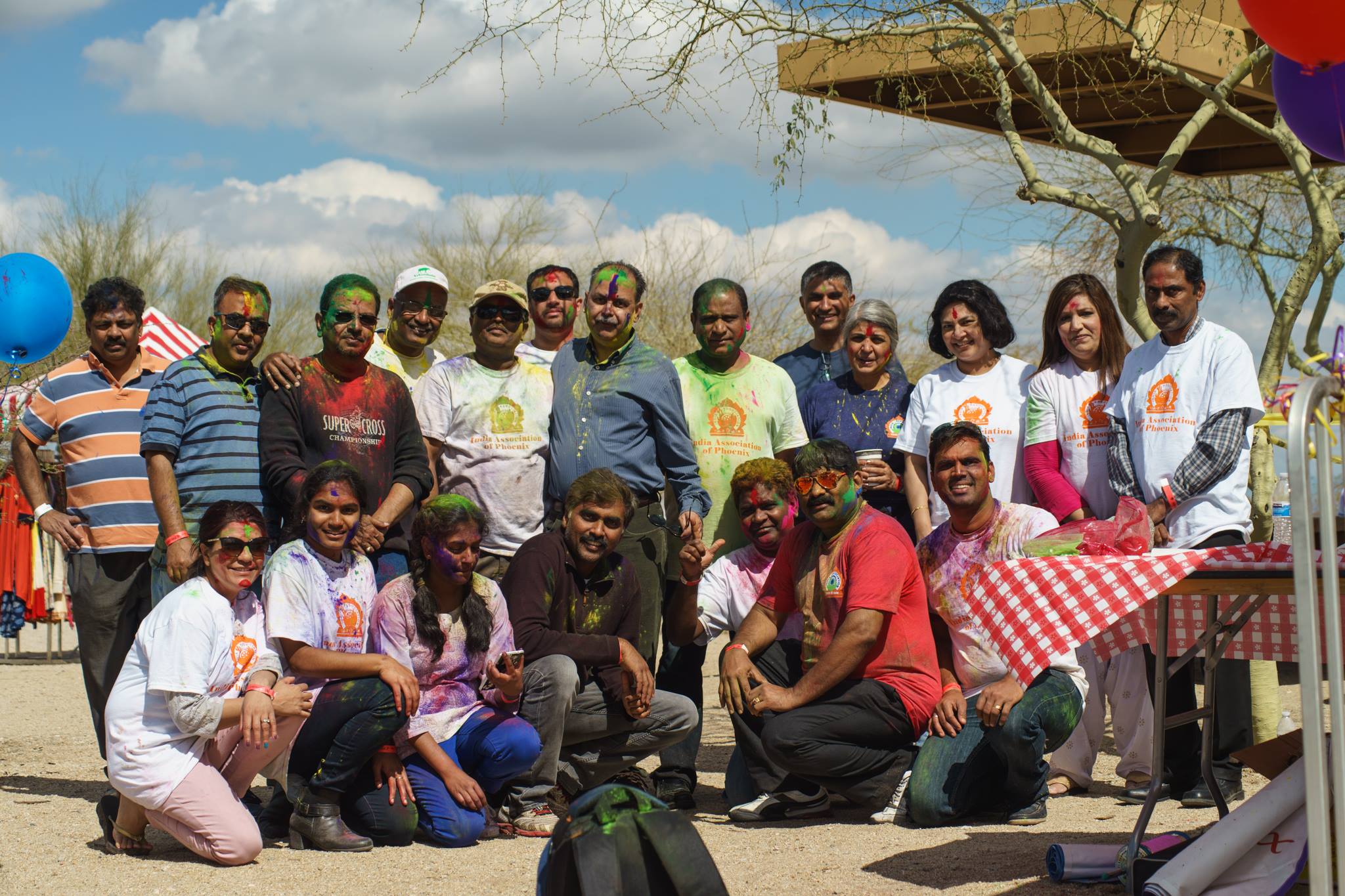
As Arizona draws its curtain to yet another season of color and love, I’ve come to admire the community that enthusiastically participates in an event that draws us closer together. Amidst the mouthwatering food and beautiful saris resonated laughter, family, and pure contentment. The landscape of South Mountain, soon turned into a colorful array of dancing paints, as if the end of the rainbow could finally be found. Watching friends reunite, coworkers coloring their nagging bosses, and children spraying random strangers, gave a sense of family and connectedness, whether young or old, North or South, Indian or American. Our festival not only brought together a community, but also a diverse nation, and added on to what is so called known as “American”: cultures appreciating other cultures, values respecting other values. This event has imprinted expectations, anticipation, and pure excitement. But how has this festival followed us from India, and why does this continue to become a part of us today?
Holi, the famous “Festival of colors”, is celebrated across India during the Spring. With increasing number of Indian immigrants, our famous festival has spread to countries such as Jamaica, Trinidad, South Africa, Malaysia, The United Kingdom, Canada and U.S.A. The rich and beautiful narrative Holi paints, has left an imprint on foreign nations, adopting Holi’s love affair with colors through Americanized events, such as the Color Run and Color Dance. But our modern depiction of Holi, however, undermines its true significance. While we associate Holi with an ageless night of dance and bhaang, we must also travel back in time to an era where the fun and religion create a beautiful fusion that narrates our Indian culture.
Holi is an ancient Hindu religious festival, but failed to exclude Non-Hindus in its popularity, reaching its reigns in many parts of South Asia and beyond. In recent years, it has spread to parts of Europe and North America as a spring celebration of love, frolic and colors.
Perhaps our culture began to influence foreign nations, when Holi was observed by Maharaja Ranjit Singh and his Sikh Empire. In 1837, Sir Henry Fane, commander -in- chief of the British Indian army, joined the Holi celebrations organized by Ranjit Singh, carrying this festival back with him post-Independence.
Holi celebrations start on the night before with a Holika Dahan where people gather, perform religious rituals before a bonfire, and pray that their internal evil be destroyed the way the demon Holika was killed in the fire. Another legend narrates the pure love between lord Krishna and Radha. A famous Indian mythological story tells us that this festival was celebrated on the rebirth of the god of Love Kama on the 40th day of Vasanth Panchami.
Our most modern understanding of the festival, celebrates the beginning of spring. However, its meaning and significance alters, depending on political and cultural provinces in India. In the 17th century, it was identified as a festival that celebrated agricultural surpluses, commemorated good spring harvests, and worshipped the fertile land. Like all religious ceremonies within a multi-linguistic nation, Holi is celebrated in different states with different names and rituals.
In Gujarat it is a two-day festival: the first day people light the bonfire to rid their evil; the second day is the festival of colors, “Dhuleti”, celebrated by sprinkling colored water and powder to each other. In Uttar Pradesh it is celebrated as Lath mar Holi in the sprawling compound of the Radha Rani Temple. In Madhura the festival lasts for sixteen days, in Kanpur it is celebrated for seven days and the last day it is celebrated on the name of the Ganga Mela. In Bihar and Jharkhand Holi is celebrated in a grand way on the name of Holi Milan which is entirely different way either before or after the actual day of Holi. In Orissa and West Bengal Holi is celebrated by the name of “Dola” or “Dolapurnima” or “Swing festival”. In Assam it is called Phakuwa, in Goa it known as Sigmo, in Maharashtra as Shimga.
Due to its popularity, the original festival has been altered to fit the defined culture of each state. As a result, the preparation and true significance has been hidden, drastically changing what it truly means to celebrate “Holi”. In the olden days, natural colors were safely by applying turmeric, sandal wood powder, and extracts of flowers and leaves. The spring season, where the weather fluctuates and leaves the brinks of winter, is believed to cause viral fever and cold. The playful throwing of natural colored powders, called Gulal, has a medical significance. However, due to the commercial availability of attractive pigments, the natural colors are replaced by synthetic ones. Perhaps we as a society, could one day return to the traditional pigments, benefiting our health, wealth, as well as the environment.
Yet despite the transformation of a once medically-benefiting festival, Holi has a new power: the power to unite the entire community, not only members of India Association. Like Radha and Krishna, couples harmoniously dance to rhythm of the falling rain. Like the Yin and Yan, grandparents gather up every ounce of energy to catch their beloved grandchildren, giving them the pampering, they lack growing up in a foreign country. Like the East and West, Americans and Indians coexist in a peaceful society, appreciating and respecting each other. Despite backgrounds and cultures, our festival paints us as humans, stripping us down to our basic instincts of compassion and humanity.
Standing behind a stall and photographing the memories made, gave me a new level of optimism. And as I watched strangers, foreigners, young, old, rich, poor, and mankind come together, I realized that it wasn’t the materialism that brings forth happiness. Its family, friends, and a community that makes us who we are.
Behind my camera lens, I had an outsider view of such a festival. Behind my laptop screen, I had a historical narrative of our culture. It was only a matter of time, before I myself, became a part of that community, and became a small pigment within the colorful community Arizona had to offer.