
Namaste everyone. Hope all readers have a good start in this new year. In our last Dec article we urged readers to take a resolution to include yoga in their daily routine. We hope you listened and took a note of it. New year comes with new hope and fresh energy. This freshness helps one to unwind and take a fresh look towards life. Everyone wants to enjoy life but to do that one needs to have a healthy body and mind which yoga can provide. Besides, yoga can give you peace, energy and ultimately purpose. So, taking advantage of freshness of mind in this new year, embrace yoga in your life.
This week we are going to focus on Ardha Ushtrasana or half camel. In Sanskrit ‘ushtra‘ means ‘Camel’ and ‘asana’ means ‘pose’. In this pose, body takes the shape of camel so it is called Ushtrasana. This asana is especially good for back problems, relaxing mind, blood circulation, respiratory system, endocrine and nervous system. All benefits are same as that for ushtrasana, but at a reduced level.
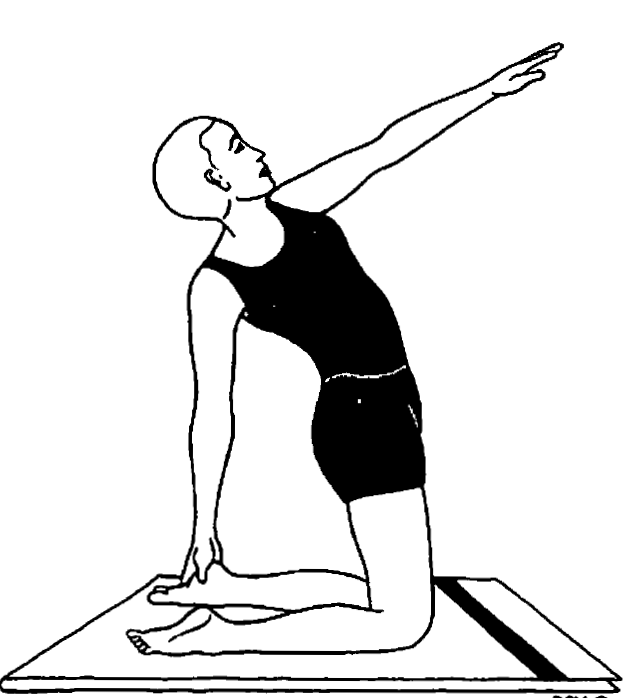
Ardha Ushtrasana (Half Camel Pose)
Steps for Ardha Ushtrasana
· Sit in vajrasana. Move the knees apart and the ankles to the side of the buttocks.
· Stand up on the knees with the arms at the sides.
· Keep the feet flat behind the body.
· Stretch the arms sideways and raise them to shoulder level.
· Do not strain in any way.
· Twist to the right, reach back with the right hand and hold the left heel or ankle.
· Simultaneously, stretch the left arm in front of the head so that the hand is at eyebrow level.
· The head should be slightly back with the eyes gazing at the raised hand.
· Push the hips forward in the final position and keep the thighs vertical.
· Hold this position while comfortable, retaining the gaze on the left hand.
· Retu
to the starting position.
· Repeat on the other side to complete one round.
· Practise 3 to 5 rounds.
Breathing:
· Inhale while stretching the arms sideways.
· Exhale while twisting to the side.
· Hold the breath out or breathe normally in the final position.
· Inhale while bringing the arms back to shoulder level.
· Exhale while releasing the arms.
Awareness: on the stretch in the back and neck, or on the normal breath if holding the posture.
Sequence: Follow supta vajrasana with a forward bending asana. The most convenient counter pose is child pose since it may be performed immediately from vajrasana without u
ecessary body movement.
Contra-indications: People with severe back ailments should not practice this asana.
Benefits:
This asana is beneficial for the digestive and reproductive systems. It stretches the stomach and intestines, alleviating constipation. The backward bend loosens up the vertebrae and stimulates the spinal nerves, relieving backache, rounded back and drooping shoulders. The posture is improved. The front of the neck is fully stretched, toning the organs in this region and regulating the thyroid gland. It is helpful for people suffering from asthma.